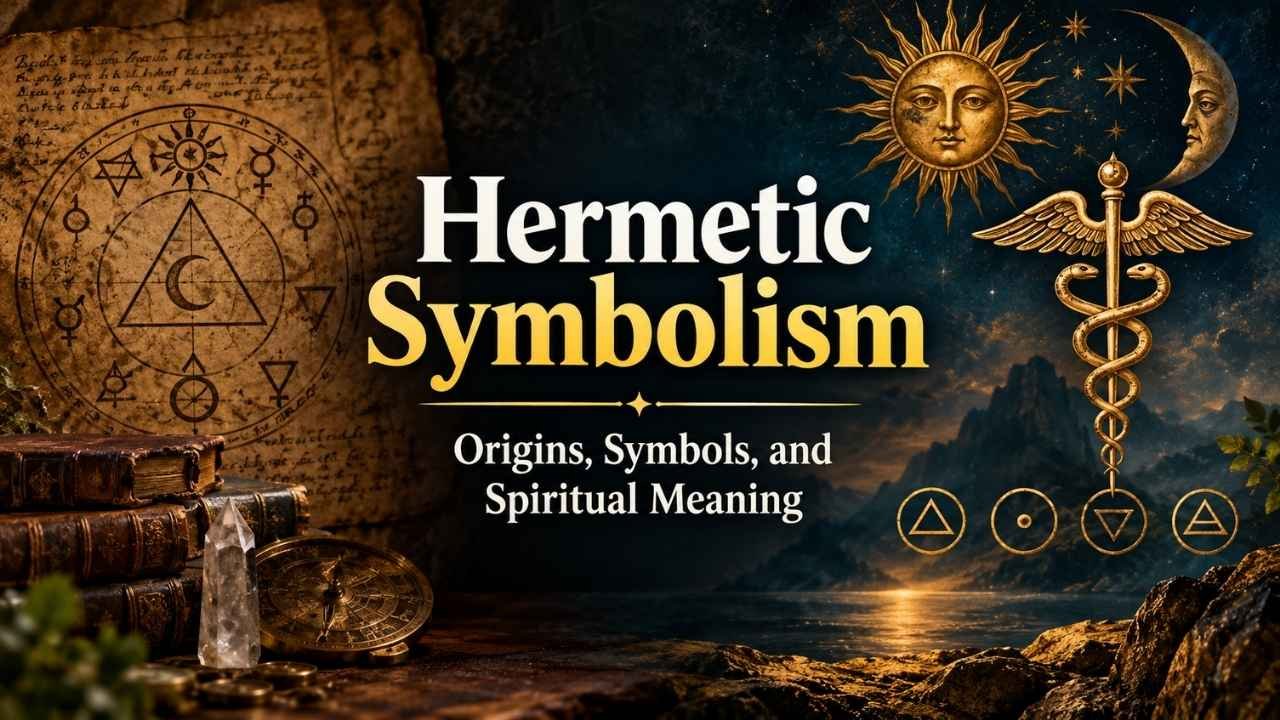
Hermetic Symbolism refers to the use of symbols, images, and ideas to express deeper truths about the universe, human nature, spiritual knowledge, and transformation. Rooted in Hermeticism, this tradition connects the visible world with hidden or spiritual meanings.
Its symbols often explore balance, unity, wisdom, cycles, and the connection between the physical and spiritual worlds. The tradition is closely linked with Hermes Trismegistus, a legendary teacher associated with Greek Hermes and the Egyptian god Thoth. Hermetic writings later influenced alchemy, astrology, philosophy, and Western esoteric traditions.
Symbols such as the Ouroboros, Caduceus, Sun, Moon, Mercury, and Philosopher’s Stone became important images in these related traditions. In this guide, we will explore the meaning of Hermetic symbolism, its origins, major Hermetic symbols and their meanings, its connection with alchemy and spiritual transformation, and how people interpret these symbols today.
Quick Answer
Hermetic symbolism uses symbols and images to express deeper ideas about wisdom, spiritual knowledge, transformation, balance, and the universe. Symbols like the Ouroboros, Caduceus, Sun, Moon, and Philosopher’s Stone represent different aspects of Hermetic thought and spiritual growth.
What Is Hermetic Symbolism?
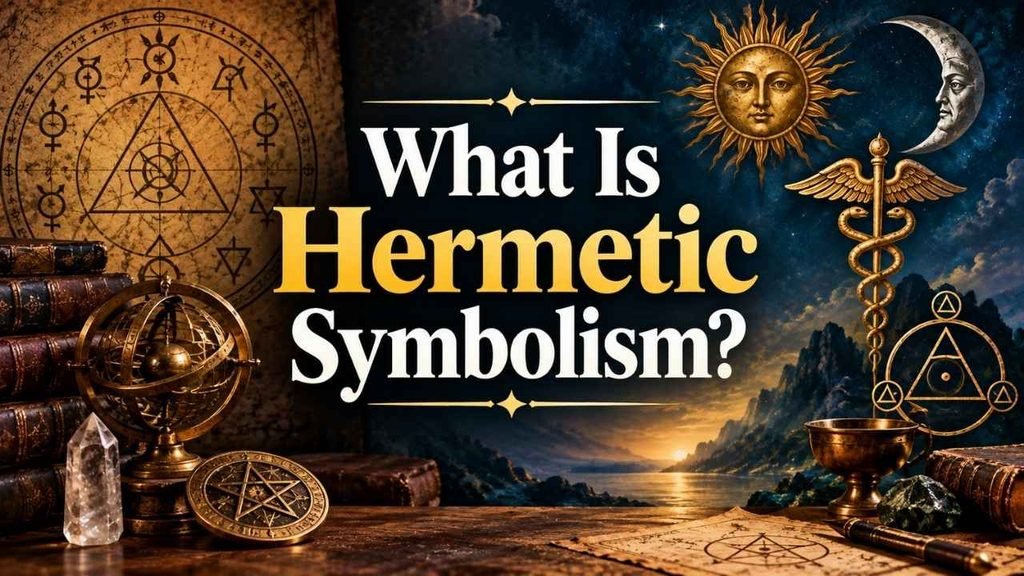
Hermetic symbolism is a system of signs, images, and ideas that helps explain deeper truths about life, nature, the mind, and the universe. The meaning of Hermetic symbolism often connects visible things with hidden ideas.
For example, a symbol may represent wisdom, balance, transformation, unity, or spiritual growth. Hermetic traditions use these symbols to make complex ideas easier to understand and remember. Hermetic symbols also appear in related areas such as alchemy, astrology, and esoteric philosophy.
They do not always have one fixed meaning, because their meaning can change with the time, text, and tradition. For beginners, the easiest way to understand Hermetic symbolism is to see it as a symbolic language. It uses familiar images to explore deeper ideas about human nature, spiritual knowledge, and the connection between the individual and the wider universe.
What Does Hermetic Mean?
The word Hermetic relates to Hermeticism, an ancient philosophical and spiritual tradition linked with Hermes Trismegistus. Hermetic thought developed in the Greco-Egyptian world and later influenced Western ideas about spirituality, nature, and hidden knowledge.
At its heart, Hermeticism explores the connection between the human being, nature, and the universe. It teaches that deeper knowledge can help a person understand both the outer world and the inner self. This idea helps explain why Hermetic symbols and their meanings often focus on wisdom, change, balance, and unity.
Hermeticism also became closely connected with alchemy, astrology, and esoteric symbolism over time. However, Hermeticism is broader than any one of these subjects. It includes ideas about spiritual knowledge, self-understanding, transformation, and the search for deeper truth.
Why Are Hermetic Symbols Important?
Hermetic symbols matter because they can express ideas that words sometimes make difficult to explain. A simple image can represent a much larger concept. For example, the Ouroboros, a serpent that forms a circle by holding its tail, can represent cycles, renewal, and eternity.
The Sun can suggest light, awareness, and knowledge, while the Moon can represent cycles and reflection. These examples show why people have used Hermetic symbolism to explore both the outer world and the inner self.
Hermetic symbols also became important in alchemy and esoteric traditions, where writers used images to describe change and spiritual growth. Their meanings can differ across sources, so readers should always consider the historical setting. Understanding this context makes Hermetic symbols and their meanings clearer and prevents modern interpretations from being confused with older teachings.
Where Did Hermetic Symbolism Come From?
The roots of Hermetic symbolism reach back to the Greco-Egyptian world, where Greek and Egyptian ideas came together. Hermetic traditions grew around writings linked to Hermes Trismegistus, a legendary teacher who combined ideas connected with the Greek god Hermes and the Egyptian god Thoth.
These writings explored God, nature, the human mind, and the structure of the universe. Over time, people used symbols to express these ideas in a simple but powerful way. Hermetic thought later influenced alchemy, astrology, magic, and Western esoteric traditions. During the Renaissance, European thinkers became deeply interested in Hermetic writings and gave them new attention.
This long history explains why Hermetic symbolism includes many layers of meaning today. Some symbols have ancient roots, while others gained new meanings through later alchemical, occult, and spiritual traditions.
Hermes Trismegistus and His Origins
Hermes Trismegistus is one of the most important figures in the history of Hermeticism. His name means “Hermes the Thrice-Greatest,” and tradition presents him as a wise teacher who shared knowledge about God, nature, the human soul, and the universe.
Ancient writers connected him with both the Greek god Hermes and the Egyptian god Thoth, who were both linked with writing, wisdom, and knowledge. Historians generally view Hermes Trismegistus as a legendary figure rather than a single historical person.
His name became attached to a group of Hermetic writings created in the Greco-Egyptian world. These texts helped shape later ideas about Hermetic philosophy, spiritual knowledge, and transformation. They also played an important role in the development of Hermetic symbolism, especially through their ideas about the relationship between humanity, nature, and the divine.
The Greco-Egyptian Roots of Hermeticism
Hermeticism developed in the ancient Greco-Egyptian world, especially around the first centuries of the Common Era. Greek and Egyptian ideas came together during this period, creating a rich tradition of philosophy, religion, and spiritual thought.
Egyptian ideas connected with Thoth, the god of wisdom and writing, while Greek traditions connected similar qualities with Hermes. Their connection later shaped the figure of Hermes Trismegistus. This background helps explain many themes found in Hermetic symbolism, including wisdom, divine knowledge, nature, and the search for hidden truth.
Hermetic thinkers explored how the human being connects with the wider cosmos. They also believed that understanding nature could help people understand themselves. These ideas later influenced alchemy, astrology, magic, and Western esoteric traditions, giving Hermetic symbols a lasting place in spiritual and philosophical thought.
The Hermetic Writings and Corpus Hermeticum
The Hermetic Writings form the main textual foundation of the Hermetic tradition. One of the best-known collections is the Corpus Hermeticum, a group of texts written in Greek and connected with Hermes Trismegistus. These writings discuss subjects such as God, creation, the human soul, nature, knowledge, and spiritual transformation.
They do not present one simple system of symbols. Instead, they provide ideas that later readers expressed through Hermetic symbolism and related traditions. Another famous text, the Emerald Tablet, became especially important in later Hermetic alchemy. Its ideas strongly influenced the famous phrase “As Above, So Below.”
During the Renaissance, European scholars rediscovered and studied these writings with great interest. Their influence helped shape later Western esotericism, alchemy, philosophy, and spiritual thought, making Hermetic texts important sources for understanding Hermetic tradition.
As Above, So Below
“As Above, So Below” is one of the most famous ideas associated with Hermetic symbolism. The phrase expresses the belief that different levels of reality can reflect or correspond with each other.
In simple terms, what happens in one part of existence may have a relationship with another part. This idea connects closely with the concepts of microcosm and macrocosm. The human being can represent a smaller version of the wider universe, while the universe represents a greater pattern that surrounds the individual.
The phrase is especially connected with the Emerald Tablet and its later interpretations. People often use it to describe cosmic correspondence, unity, and interconnectedness. However, its meaning can change depending on the source. Modern spiritual writers may use the phrase more broadly than ancient Hermetic texts originally intended.
Unity of Mind, Matter, and Spirit
A major theme in Hermetic philosophy involves the relationship between the mind, the physical world, and the spiritual world. Hermetic teachings often encourage people to look beyond the surface of material life and search for deeper meaning.
This does not always mean rejecting the physical world. Instead, Hermetic thought can present nature, the human mind, and spiritual reality as parts of a connected whole. This idea supports the wider concept of microcosm and macrocosm, where the individual reflects patterns found in the larger universe.
Hermetic symbolism often expresses this connection through circles, geometric forms, planetary images, and alchemical symbols. These images can represent unity, balance, consciousness, and cosmic order. For many modern readers, this idea also connects with self-knowledge and spiritual growth, because understanding the world can become a way to understand oneself.
Transformation and Spiritual Rebirth
Transformation stands at the heart of many Hermetic teachings and symbols. Hermetic traditions often describe knowledge as something that can change the person who seeks it. Instead of simply collecting information, a seeker aims to develop greater awareness and deeper self-knowledge.
This process can resemble spiritual rebirth, where an old way of thinking gives way to a new understanding. Hermetic alchemy strengthened this theme through images of purification, death, renewal, and transmutation.
The transformation of ordinary matter became a powerful symbol for inner transformation. The Philosopher’s Stone, for example, became associated with the highest stage of alchemical transformation. In modern spirituality, people may interpret these symbols as signs of personal growth, spiritual awakening, enlightenment, and inner wisdom. This makes Hermetic symbolism meaningful beyond its historical setting.
Major Hermetic Symbols and Their Meanings
Hermetic symbols use familiar images to express ideas about nature, consciousness, transformation, and spiritual knowledge. Some symbols have strong connections with Hermetic or alchemical traditions, while others gained Hermetic meanings through later writers and artists.
This is important because not every symbol called Hermetic originally belonged only to Hermeticism. Symbols such as the Ouroboros, Sun, Moon, Mercury, circle, and triangle have appeared in several cultures and traditions. Their meanings can also change depending on the historical period and source.
Still, these images remain important when people study Hermetic symbolism and its meanings today. They often represent themes such as unity, balance, cycles, wisdom, transformation, and hidden knowledge. Looking at each symbol separately helps explain how Hermetic thinkers and later esoteric writers used images to communicate deeper philosophical and spiritual ideas.
The Caduceus
The Caduceus features a staff with two snakes winding around it, often topped with wings. It is strongly associated with Hermes, making it relevant to Hermetic symbolism. The symbol can represent communication, movement, exchange, duality, balance, and transformation. However, its ancient history predates Hermeticism, and it differs from the single-snake Rod of Asclepius.
The Ouroboros
The Ouroboros depicts a serpent or dragon eating its tail in a complete circle. In Hermetic and alchemical symbolism, it represents cycles, eternity, renewal, death, rebirth, unity, and transformation. Its circular form suggests that endings and beginnings are connected, reflecting the continuous process of change and the unity of opposing forces.
The Sun
The Sun is a major symbol of light, life, awareness, knowledge, and consciousness. In Hermetic and alchemical traditions, it is linked with gold, representing purity, perfection, and transformation. In modern interpretations, the Sun can symbolize inner wisdom, enlightenment, vitality, confidence, and discovering hidden knowledge.
The Moon
The Moon symbolizes cycles, reflection, change, intuition, and hidden experiences. In Hermetic and alchemical symbolism, its changing phases represent renewal, death, rebirth, and transformation. Its reflected light can also represent the relationship between visible and hidden aspects of life, consciousness and the unconscious, or active and receptive forces.
Mercury
Mercury holds an important place in Hermeticism and alchemy, connecting with Hermes and ideas of movement, communication, flexibility, and transformation. As one of the three alchemical principles alongside Sulfur and Salt, Mercury represents something changeable and difficult to fix. It can therefore symbolize adaptability, transformation, and spiritual development.
The Philosopher’s Stone
The Philosopher’s Stone is a famous symbol of Hermetic alchemy, traditionally associated with transforming base metals into gold. Symbolically, it can represent inner transformation, self-knowledge, enlightenment, spiritual rebirth, and perfection. It is also connected with the Great Work, representing the journey from an undeveloped state toward a higher state of being.
The Triangle
The triangle appears throughout Hermetic and alchemical symbolism. Its three sides can represent different groups of three, including Mercury, Sulfur, and Salt. Depending on context, triangles may symbolize unity, balance, creation, transformation, and spiritual development. Their meaning varies across traditions, so the surrounding text or diagram is important.
The Circle
The circle is a powerful form in Hermetic symbolism, representing unity, eternity, wholeness, cycles, and completion. Because it has no obvious beginning or ending, it can express continuous transformation and interconnectedness. The circle also appears in symbols such as the Ouroboros, reinforcing ideas of cosmic order and spiritual completion.
The Cross and Four Directions
The cross appears in many traditions and is not exclusively Hermetic. In Hermetic and alchemical symbolism, its four arms can represent the four elements: Earth, Water, Air, and Fire. It may also symbolize balance, structure, stability, nature, and transformation, depending on the historical context and symbolic system.
Alchemical Symbols and Sigils
Alchemical symbols and sigils helped represent metals, planets, elements, substances, and stages of transformation. Common examples include symbols for Mercury, Sulfur, Salt, gold, silver, and the four elements. However, not every alchemical symbol is Hermetic, and not every occult sigil is ancient. Their meanings developed across different periods and traditions.
Conclusion
Hermetic symbolism offers a meaningful way to explore wisdom, spiritual knowledge, transformation, balance, and the connection between the human being and the universe.
From Hermes Trismegistus and the ancient Hermetic writings to alchemy, the Ouroboros, Caduceus, Sun, Moon, Mercury, and Philosopher’s Stone, these symbols have carried different meanings across time.
Understanding their historical background helps us separate traditional Hermetic ideas from later occult and modern spiritual interpretations. At its heart, Hermetic symbolism encourages deeper self-knowledge, spiritual growth, and awareness of the hidden connections within life.
Whether you study it through history, philosophy, alchemy, or spirituality, its symbols can offer a powerful way to think about change, unity, renewal, and personal transformation.
2 thoughts on “Hermetic Symbolism : Origins, Symbols, and Spiritual Meaning”