
The mitigate definition and meaning can help you understand how to describe reducing harm, danger, or the seriousness of a difficult situation. You may encounter this word in everyday conversations, workplace discussions, legal documents, and news reports.
Although it sounds formal, its meaning is relatively simple: to make something less severe, harmful, or unpleasant. Understanding how to use mitigate correctly can improve your vocabulary and make your English communication more precise.
Quick Answer
Mitigate means to make something less severe, harmful, painful, or serious. It describes an action that reduces the negative effects of a problem without necessarily removing the problem completely. For example, wearing a seat belt can help mitigate the risk of serious injury during a car accident. The word is commonly used in everyday, professional, environmental, and legal contexts.
What Does Mitigate Mean in Simple Words?
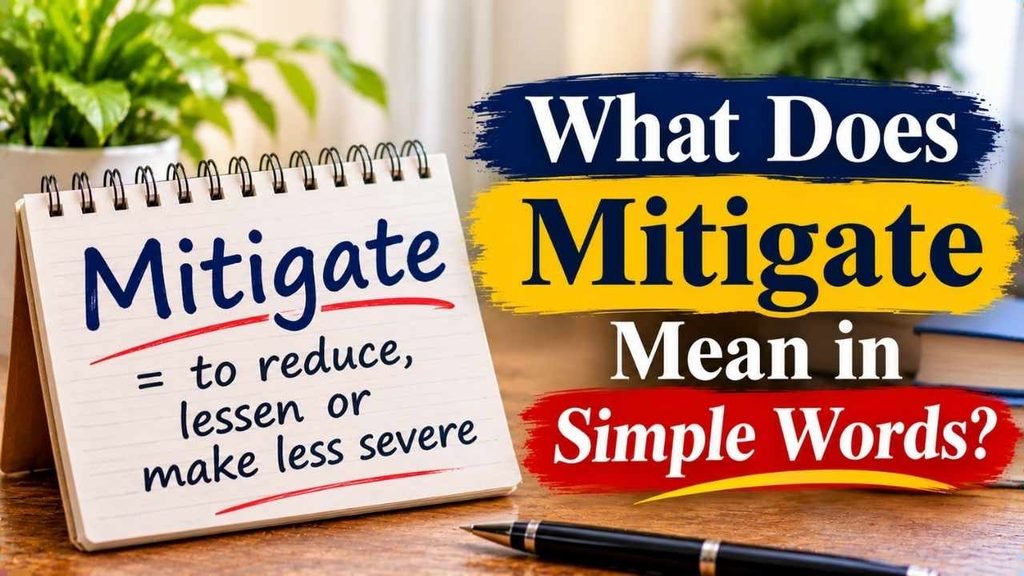
In simple English, mitigate means to make a bad situation less bad. It involves taking steps to reduce the damage, difficulty, or unpleasant effects of something.
For example, imagine that heavy rain causes flooding in your neighborhood. Installing proper drainage systems may help mitigate the damage. The rain may still occur, but its harmful effects can become less serious.
Here are a few simple examples:
- Drinking enough water may mitigate the effects of dehydration.
- Better security measures can mitigate the risk of theft.
- Taking breaks may mitigate stress during a busy workday.
- Planting trees can help mitigate the effects of extreme heat.
The important idea is that mitigation focuses on reducing negative effects rather than guaranteeing a complete solution.
How to Pronounce Mitigate
The word mitigate is pronounced:
MIT-ih-gayt
- Phonetic spelling: /ˈmɪtɪɡeɪt/
- Syllables: MIT-i-gate
- Number of syllables: Three
- Part of speech: Verb
The first syllable receives the main stress. The word is pronounced similarly in standard British and American English. You can remember its pronunciation by dividing it into three parts: mit, i, and gate.
Mitigate in a Sentence: Practical Examples
Seeing the word in context makes its meaning easier to understand. Here are original examples from different situations.
Everyday life
- Regular exercise can help mitigate the negative effects of a sedentary lifestyle.
- She apologized to mitigate the tension between her friends.
- Closing the windows helped mitigate the noise coming from outside.
Workplace and business
- The company introduced new safety rules to mitigate workplace risks.
- Effective communication can mitigate misunderstandings between employees.
- The manager created a backup plan to mitigate potential financial losses.
Health and safety
- Wearing protective equipment can mitigate the risk of workplace injuries.
- Rest and proper hydration may help mitigate the effects of physical exhaustion.
Environment
- Planting more trees can help mitigate the effects of rising temperatures.
- Governments are introducing measures to mitigate environmental damage.
In each sentence, mitigate describes an action intended to make an unwanted situation less harmful or severe.
Synonyms of Mitigate
Synonyms are words with similar meanings. The best alternative depends on the situation and the type of problem being discussed.
| Synonym | Meaning |
| Alleviate | Make pain or difficulty easier |
| Lessen | Make something smaller or weaker |
| Reduce | Decrease the amount or degree |
| Ease | Make something less difficult or uncomfortable |
| Moderate | Make something less extreme |
| Soften | Make something less harsh or severe |
| Diminish | Make something less strong or important |
For example, you can say that a treatment may alleviate pain, while safety precautions may mitigate risks.
Although these words are related, they are not always interchangeable. Choosing the right synonym depends on the sentence and its intended meaning.
Antonyms of Mitigate
Antonyms are words that express the opposite meaning.
Common antonyms of mitigate include:
- Aggravate: Make a problem or situation worse.
- Worsen: Make something more serious or unpleasant.
- Intensify: Increase the strength or severity of something.
- Exacerbate: Make an existing problem more severe.
- Increase: Make something greater in amount or degree.
For example:
- Mitigate: The new policy helped mitigate the problem.
- Aggravate: The new policy aggravated the problem.
Understanding these opposite words can help you use mitigate more accurately in writing and conversation.
Mitigate vs. Similar Words
Several English words have meanings close to mitigate, but each has a slightly different emphasis.
| Word | Meaning | Example |
| Mitigate | Make something less severe | Reduce the risk of injury |
| Alleviate | Make pain or difficulty easier | Alleviate emotional distress |
| Reduce | Make something smaller or lower | Reduce expenses |
| Minimize | Make something as small as reasonably possible | Minimize errors |
| Prevent | Stop something from happening | Prevent an accident |
| Eliminate | Remove something completely | Eliminate a source of pollution |
Mitigate vs. prevent: Mitigate means reducing the severity or effects of something, while prevent means stopping it from happening in the first place. For example, a fire alarm may help prevent serious harm by providing an early warning, while fire-resistant materials may mitigate damage.
Mitigate vs. alleviate: Both words suggest making something less severe. However, alleviate is frequently associated with pain, discomfort, and emotional distress, while mitigate is often used for risks, damage, and harmful consequences.
Mitigate vs. minimize: Minimize emphasizes making something as small as possible. Mitigate focuses on reducing the severity or harmful effects of a situation.
These distinctions help you select the most accurate word for your intended message.
Different Forms of the Word Mitigate
Mitigate is a verb. It has several grammatical forms that are useful in English writing.
| Word form | Grammatical use | Example |
| Mitigate | Base verb | We must mitigate the risks. |
| Mitigates | Third-person singular | This measure mitigates damage. |
| Mitigated | Past tense/past participle | The treatment mitigated the symptoms. |
| Mitigating | Present participle | They are mitigating the effects. |
| Mitigation | Noun | Risk mitigation is important. |
The noun mitigation refers to the process or action of making something less harmful or severe.
For example, risk mitigation means taking steps to reduce the possibility or consequences of potential risks.
How Is Mitigate Used in Everyday and Professional English?
Although mitigate is a relatively formal word, it appears in several areas of communication.
Everyday communication
People use it when discussing ways to make uncomfortable or difficult situations easier.
Example: A sincere conversation helped mitigate the disagreement between the two friends.
Business and workplace communication
Businesses use the term when discussing financial problems, operational challenges, safety concerns, and uncertainty.
Example: The organization developed a strategy to mitigate potential losses.
Environmental discussions
The word frequently appears in conversations about climate change, pollution, and environmental protection.
Example: Governments are investing in renewable energy to mitigate the effects of climate change.
Legal contexts
The expression mitigating circumstances refers to facts or conditions that may reduce the perceived seriousness of an offense or influence a legal decision.
For example, a court may consider relevant mitigating circumstances when determining an appropriate sentence. Their legal significance depends on the jurisdiction and the particular case.
Common Mistakes When Using Mitigate
Even though its meaning is straightforward, some mistakes can occur when using this word.
Confusing mitigation with prevention
Mitigating something does not always mean preventing it.
Incorrect understanding: Mitigation guarantees that a problem will never happen.
Correct understanding: Mitigation reduces the severity or consequences of a problem.
Using mitigate when eliminate is intended
Mitigate does not necessarily mean removing something entirely.
For example, a safety measure may mitigate the risk of an accident without eliminating every possible danger.
Confusing mitigate with militate
These words look and sound similar, but their meanings are different.
- Mitigate means to make something less severe.
- Militate means to have a significant influence, often against something.
For example, better planning may mitigate risks, while certain circumstances may militate against a successful outcome.
Overusing formal vocabulary
Sometimes a simpler word communicates an idea more clearly. If you are speaking casually, reduce, ease, or lessen may sound more natural than mitigate.
Choose the word that best suits your audience and situation.
FAQ’S
What does mitigate mean in simple terms?
Mitigate means to make something less harmful, serious, or unpleasant. In simple words, it means making a bad situation less bad.
Is mitigate a positive or negative word?
Mitigate generally has a positive meaning because it describes an effort to reduce harm or difficulty. However, the word itself is neutral and describes an action rather than guaranteeing a positive result.
What is another word for mitigate?
Common alternatives include alleviate, reduce, lessen, ease, moderate, soften, and diminish. The best synonym depends on the context.
What is the opposite of mitigate?
Common opposites include aggravate, worsen, intensify, exacerbate, and increase. These words describe making a situation more serious or severe.
Is mitigate a formal word?
Yes. Mitigate is generally considered a formal or moderately formal word. It is particularly common in business, academic, legal, environmental, and professional writing.
Does mitigate mean prevent?
No. Mitigate means reducing the severity or harmful effects of something. Prevent means stopping something from happening. Mitigation can reduce consequences even when prevention is not possible.
What does mitigating circumstances mean?
Mitigating circumstances are relevant facts or conditions that may make an offense appear less serious or influence the decision about an appropriate legal consequence.
Conclusion
The word mitigate means to make something less severe, harmful, or unpleasant. It is useful when discussing risks, damage, stress, environmental problems, and difficult situations. Its related forms include mitigates, mitigated, mitigating, and mitigation. Remember that mitigating a problem does not necessarily mean eliminating it. Once you understand this distinction, you can use the word more confidently and accurately in everyday conversations, academic writing, and professional communication.
1 thought on “Mitigate Definition & Meaning: Examples and Correct Usage”