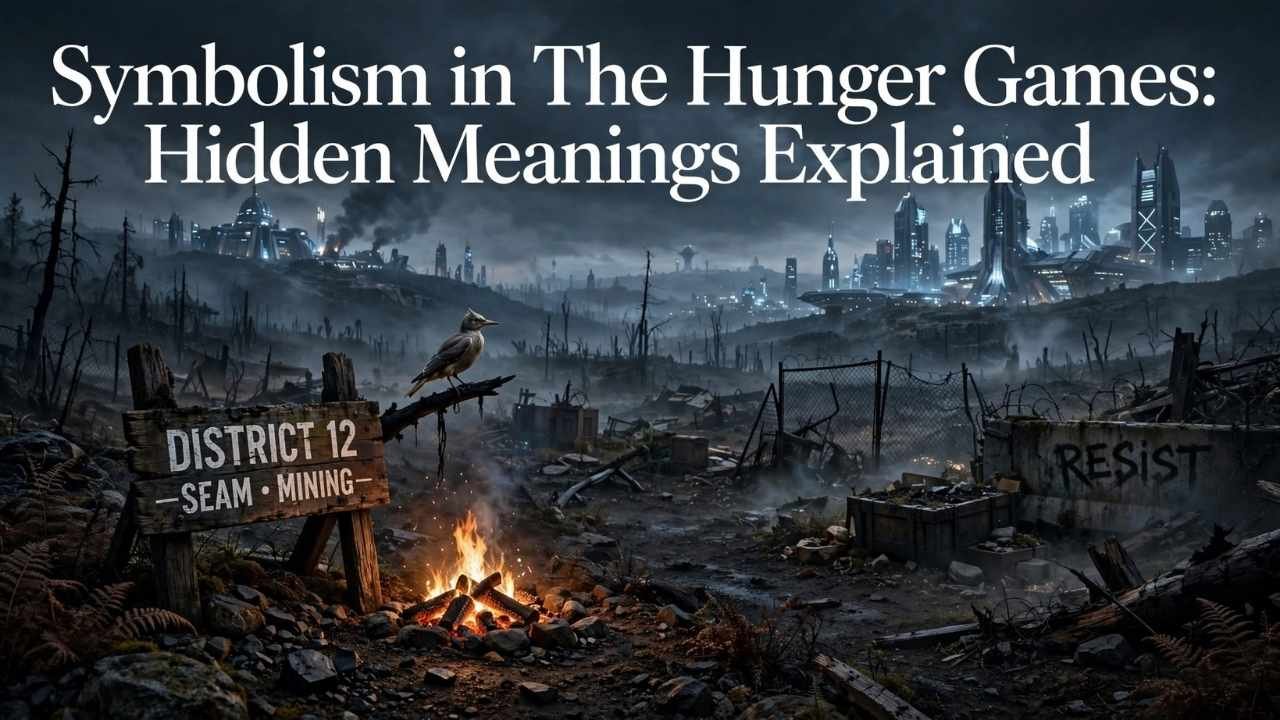
Symbolism in The Hunger Games gives deeper meaning to many parts of Suzanne Collins’s story. The novel does more than show a fight for survival. It uses objects, places, actions, and characters to explore power, rebellion, hope, freedom, inequality, and identity.
Some symbols appear again and again, while others become important at key moments in Katniss’s journey. The mockingjay, fire, bread, flowers, nightlock berries, and bow and arrow all carry meanings beyond their basic roles in the story.
These symbols also connect with major themes such as survival, oppression, sacrifice, and resistance. By understanding the Hunger Games symbolism, readers can see why small details matter so much.
Collins uses these symbols to show how people can protect their humanity even when a powerful government tries to control them.
Quick Answer
Symbolism in The Hunger Games gives deeper meaning to objects, characters, and events throughout the novel. The mockingjay represents rebellion and hope, while fire represents strength and transformation. Bread symbolizes survival and kindness, and nightlock berries represent choice and defiance. Together, these Hunger Games symbols highlight themes of freedom, oppression, survival, identity, and resistance.
What Does Symbolism Mean in The Hunger Games?
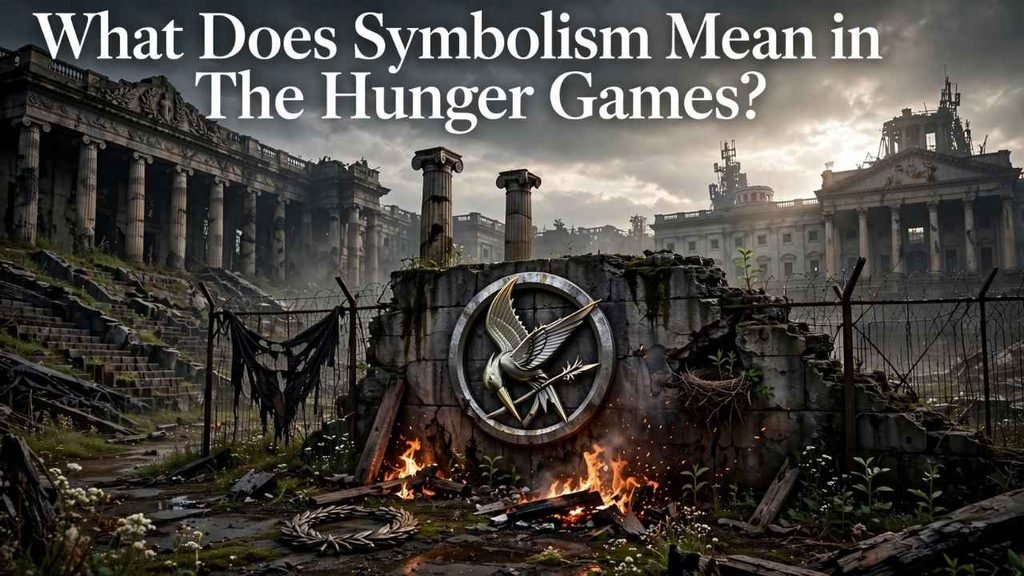
Symbolism means using something simple to represent a deeper idea. In The Hunger Games, Collins uses objects, places, and actions to communicate ideas about society and human behavior. For example, the mockingjay symbol represents rebellion and hope, while bread can represent survival, kindness, and human connection.
A motif works differently because it is an idea, image, or object that appears many times and supports a theme. An allegory uses a story or its parts to represent larger ideas about real life. These literary devices work together throughout the novel.
Understanding symbols and meanings in The Hunger Games helps readers notice how Collins develops her themes. Instead of simply telling readers about oppression or freedom, she lets important symbols show these ideas through the story.
Why Suzanne Collins Uses Symbols
Suzanne Collins uses literary symbolism in The Hunger Games to make important ideas easier to understand and remember. A simple object can carry a strong message without a long explanation.
The mockingjay can show rebellion, while fire can show Katniss’s changing identity. Bread can remind readers of kindness during difficult times. These symbols also help connect Katniss’s personal experiences with the larger problems in Panem. For example, Katniss wants to survive, but she also slowly becomes a symbol of resistance against Capitol control.
This makes her journey more meaningful. Collins also uses symbolism to show how people can give new meaning to things that once belonged to the Capitol. Through recurring symbols, motifs, and imagery, the novel explores survival, power, identity, inequality, and the struggle for freedom.
Mockingjay — Rebellion, Defiance, and Hope
The mockingjay stands as one of the strongest symbols in The Hunger Games. The bird represents rebellion, defiance, freedom, and hope because the Capitol never fully controlled it. Katniss first connects with the mockingjay through her father and later through Rue.
The bird becomes even more important when Katniss wears the mockingjay pin during the Games. Her actions give the symbol a new meaning. What begins as a personal reminder of home slowly becomes a public sign of resistance.
The mockingjay also shows that the Capitol cannot control everything. Katniss does not choose to become a rebellion symbol at first, but people begin to see her actions as signs of hope. This mockingjay symbolism shows how ordinary acts can grow into powerful forms of resistance.
Fire — Identity, Transformation, and Rebellion
Fire symbolism plays an important role in Katniss’s character development. Cinna helps create her public image as the Girl on Fire, turning fire into a symbol of strength, courage, and change. Katniss already shows these qualities through her actions, but her costumes help other people notice them.
Fire also represents her growing power as she moves from simply trying to survive toward challenging Capitol control. The image of fire has another meaning because it can destroy old things and create something new. In this way, Katniss fire symbolism connects with her changing identity.
She starts as a girl focused on protecting her family, but she becomes a figure who inspires others. The Girl on Fire symbolism therefore represents both personal transformation and the growing spirit of rebellion in Panem.
Bread — Survival, Compassion, and Hope
Bread symbolism in The Hunger Games connects strongly with survival and kindness. Peeta’s bread becomes important because it helps Katniss during one of the hardest moments in her childhood. His family gives her food when she has almost lost hope. Later, bread continues to represent care, survival, and human connection between Katniss and Peeta.
The Capitol uses food as part of its system of control, but bread can also bring people together. This creates an important contrast. Something as simple as food can represent both power and kindness.
Peeta’s bread symbolism also shows that survival does not depend only on physical strength. Compassion can help people survive difficult situations too. Through bread, Collins connects hunger, hope, friendship, and survival, showing why small acts of kindness can have lasting effects.
Nightlock Berries — Choice, Defiance, and Power
The nightlock berries become one of the clearest symbols of defiance in the novel. Katniss and Peeta use the berries when they appear ready to die rather than allow the Capitol to control their final choice. The berries therefore represent choice, resistance, courage, and rebellion.
Katniss understands that the Gamemakers want complete control over the Games, so she turns their rules against them. This moment shows that even people with little political power can sometimes challenge an oppressive system.
The nightlock symbolism also connects with survival because Katniss uses the threat of death to protect her and Peeta. The berries create a powerful message: the Capitol may control the arena, but it cannot completely control the choices people make. Nightlock berries symbolism therefore represents freedom through defiance.
Bow and Arrow — Independence, Survival, and Responsibility
Katniss’s bow and arrow represent much more than a weapon. They connect her with her father, who taught her how to hunt before his death. The bow gives Katniss a way to provide food for her family and protect the people she loves.
Because of this, it becomes a symbol of independence, survival, skill, and responsibility. Katniss feels confident when she uses her bow because it gives her control in a world where powerful people often control her choices.
The weapon also separates her from the Capitol’s image of a helpless tribute. She becomes an active player who can make her own decisions. Katniss’s bow and arrow therefore support her character development. They show how her survival skills help her protect her identity while facing danger, fear, and political control.
The Arena — Control, Spectacle, and Inequality
The Hunger Games arena represents the Capitol’s ability to control people and turn suffering into entertainment. The Capitol creates the arena, controls its rules, and watches the tributes fight for survival. This makes the arena a powerful symbol of government control, inequality, fear, and spectacle.
The tributes have almost no freedom because the Capitol controls nearly every part of their experience. At the same time, wealthy citizens watch the Games as entertainment. This contrast shows the moral gap between the Capitol and the districts. For the Capitol, the arena becomes a show.
For the tributes, it becomes a fight for life. The arena symbolism also reflects the larger society of Panem. Collins uses it to show how an authoritarian government can use fear and entertainment to keep people powerless.
Three-Finger Salute — Respect, Grief, Unity, and Resistance
The three-finger salute becomes a meaningful symbol of respect and resistance. Katniss first sees it as a gesture from District 12, but its meaning grows after Rue’s death. The people of District 11 use the gesture to show respect for Katniss and grief for Rue.
Katniss returns the gesture, creating a powerful moment of connection between people from different districts. Later, the salute becomes linked with unity and rebellion against the Capitol. The government may divide the districts, but shared symbols can bring people together.
This is why the three-finger salute symbolism matters beyond one character or district. It shows that small acts can communicate strong feelings without words. The gesture represents respect, grief, solidarity, and resistance, making it one of the novel’s clearest signs of growing unity.
Rue’s Flowers — Innocence, Grief, and Humanity
Rue’s flowers symbolism connects innocence, beauty, grief, and human dignity. After Rue dies, Katniss covers her body with flowers instead of leaving her as another victim of the Games.
This action shows that Rue was a person with a life, dreams, and relationships, not simply a tribute for public entertainment. The flowers also create a strong contrast with the violence of the arena.
Their beauty reminds readers of the innocence that the Capitol destroys through the Games. Katniss’s act becomes a quiet form of defiance because she refuses to treat Rue’s death as entertainment. The flowers therefore represent both mourning and resistance.
Through flower symbolism in The Hunger Games, Collins shows that kindness can challenge cruelty. Katniss protects Rue’s humanity even when the Capitol tries to take it away.
Dandelion — Hope After Despair
The dandelion represents hope, survival, and the possibility of a better future. Katniss remembers seeing a dandelion after her father’s death, when she believed her family might not survive.
The flower reminds her that she can find food and continue living. This small moment becomes important because it changes Katniss’s view of her future. The dandelion therefore connects strongly with hope and survival. Unlike the Capitol’s symbols of wealth and control, the dandelion grows naturally and can appear in ordinary places.
It shows that hope does not always come from powerful people. Sometimes it grows from a small discovery during a difficult time. The dandelion symbolism also connects with Katniss’s strength. She learns that survival can begin with one small reason to keep going.
White Roses — Beauty, Fear, and Manipulation
White roses become closely connected with President Snow and his control over Katniss. Roses normally suggest beauty, purity, or peace, but Snow gives the flower a darker meaning. His roses represent power, fear, manipulation, and hidden threats. Snow uses beauty to hide violence, just as the Capitol uses luxury to hide the suffering of the districts.
This contrast makes the white rose symbolism especially important. A beautiful flower can still carry a frightening message when Snow uses it to remind Katniss that he can reach her. The roses also connect with the Capitol’s obsession with appearances.
Everything must look perfect even when people suffer behind the scenes. Through rose symbolism in The Hunger Games, Collins shows how powerful people can use beauty and polite behavior to hide control and fear.
Katniss’s Dresses and Clothing — Identity and Performance
Katniss’s dresses show how the Capitol controls public image and uses appearance as part of its political system. Cinna designs her clothing to create a strong identity for Katniss, especially through the image of the Girl on Fire.
Her costumes make her memorable to viewers and help her gain support from sponsors. However, the clothing also creates a conflict between her real identity and the person she must perform for the cameras.
Katniss does not always feel comfortable with the role the Capitol creates for her. Still, Cinna uses fashion as a quiet form of resistance. The clothing symbolism in The Hunger Games shows that appearance can become a tool of both control and rebellion. Through costumes, Collins explores identity, media manipulation, performance, and political messaging.
Panem — Bread, Rome, and Political Control
Panem symbolism connects the fictional country with ideas about political power, control, and social inequality. The name Panem comes from the Latin word for bread, which connects to the idea of “bread and circuses.”
Ancient Roman leaders used food and entertainment to keep people satisfied and distracted. Collins brings a similar idea into the novel through the Hunger Games. The Capitol gives people entertainment while it controls the districts through fear. This makes Panem in The Hunger Games more than just a setting.
It represents a society where powerful leaders use resources, media, and violence to maintain control. The contrast between the wealthy Capitol and poor districts also highlights class inequality. Through Panem symbolism, Collins shows how governments can use entertainment and fear to distract people from injustice.
Real vs Fake — Performance, Identity, and Survival
The contrast between real and fake appears throughout The Hunger Games. Katniss often struggles to separate her true feelings from the image she must show to the audience. Her relationship with Peeta creates this problem because the Capitol wants a romantic story that viewers will enjoy.
Katniss sometimes acts according to this expectation because she needs sponsors and protection. However, real emotions also develop between the characters. This real vs fake symbolism shows how survival can force people to perform different versions of themselves.
The Capitol turns personal feelings into entertainment and political messaging. Katniss must decide when to act and when to remain true to herself. Through this contrast, Collins explores identity, media manipulation, performance, survival, and public image, showing how difficult it can become to stay real under constant pressure.
Hunger — Survival, Freedom, and Dignity
Hunger symbolism in The Hunger Games reaches far beyond the physical need for food. Katniss experiences hunger from childhood because District 12 suffers from poverty and limited resources. The Capitol, however, enjoys plenty of food and luxury. This contrast reveals the deep economic inequality between the Capitol and the districts.
Hunger also represents a deeper desire for freedom, dignity, safety, and justice. Katniss wants more than enough food to survive. She wants a life where her family does not fear starvation or government punishment.
The Games use hunger as another form of control because people who struggle to survive have fewer choices. Collins therefore connects physical hunger with political hunger. People begin to want freedom just as strongly as they want food. This makes hunger an important survival motif throughout the novel.
Reaping — Fear, Sacrifice, and Government Power
The Reaping represents fear, sacrifice, and the Capitol’s control over the districts. Each year, children must enter a public event where the government selects tributes for the Games. The event appears organized and formal, but it hides extreme cruelty.
Families cannot stop the process because the Capitol controls the rules. Katniss’s decision to volunteer for Prim shows how the Reaping symbolism connects with love and sacrifice. She accepts danger to protect her younger sister.
The Reaping also reminds the districts that the Capitol can take their children whenever it wants. This creates fear and keeps people obedient. At the same time, Katniss’s choice becomes an early sign of resistance because she refuses to let the Capitol decide everything about her family. The Reaping therefore represents government power, fear, sacrifice, and defiance.
Avox — Silence and Loss of Voice
The Avox represents silence, fear, punishment, and the loss of personal freedom. The Capitol punishes people who resist its authority by taking away their voices and forcing them into service.
Katniss notices an Avox girl named Darius and feels uncomfortable because she knows the system has treated her cruelly. The Avox system shows how the Capitol controls not only people’s actions but also their ability to speak.
This creates an important contrast between voice and silence. Speaking can express identity, truth, and resistance, while forced silence protects those in power. The Avox symbolism therefore connects with oppression and government control.
Collins uses these characters to show that authoritarian power can punish people for refusing to obey. Their silence becomes a reminder of what happens when a society removes freedom and human dignity.
Gifts and Sponsors — Survival With Strings Attached
Gifts and sponsors show how survival in the Games depends partly on public opinion and wealth. Tributes can receive food, medicine, or useful supplies from sponsors, but they must first attract attention and sympathy.
This turns survival into another kind of performance. Katniss and Peeta understand that the audience can influence their chances, so they carefully manage their public image. The sponsor symbolism also reveals inequality because some tributes receive more support than others.
Wealth and popularity can become almost as important as physical skill. The Capitol presents this system as entertainment, but it creates a cruel connection between survival and public approval.
Through gifts and sponsors in The Hunger Games, Collins shows how power can control people through rewards as well as punishment. Even help can come with expectations, pressure, and hidden costs.
The Fence — Boundaries, Control, and Forbidden Freedom
The fence around District 12 represents boundaries, control, and the limits placed on people’s freedom. The fence separates the district from the outside world, but Katniss often finds ways to move beyond it. She hunts in the woods because the forest gives her food and a sense of independence.
This creates a contrast between the controlled district and the natural world outside it. The fence symbolism therefore connects with the struggle between restriction and freedom. Although the fence appears to protect the district, it also reminds people that the Capitol controls where they can go. Katniss’s ability to cross the boundary shows her independent nature.
The fence can also represent the invisible limits created by fear and government power. Collins uses this symbol to show that freedom often begins when people question the boundaries placed around them.
How Symbolism Changes Meaning Throughout the Story?
One of the strongest parts of The Hunger Games symbolism is how certain symbols change meaning as Katniss develops. At first, the mockingjay feels like a simple connection to home and her father. Later, it becomes a sign of rebellion and hope for others.
Fire begins as part of Katniss’s costume, but it grows into a symbol of her strength and changing identity. Bread first represents a childhood act of kindness, but it later connects Katniss and Peeta through survival.
Even the nightlock berries change from dangerous plants into symbols of defiance. These changes make the symbols feel natural rather than forced. Collins shows that meaning can grow through experience. As Katniss changes, the symbols around her also gain new meaning. This helps readers understand her character development and the growing resistance against the Capitol.
Symbols That Work as Opposites
Collins often places opposite symbols together to highlight the main conflicts in the novel. Hunger and excess show the difference between poor districts and the wealthy Capitol. Voice and silence contrast freedom of expression with government punishment.
Nature and artificial beauty separate the simple world of District 12 from the Capitol’s controlled lifestyle. Real and performed emotions show the difference between Katniss’s true identity and the image she presents for the cameras.
Life and death also appear throughout the Games, where survival always comes with the threat of losing someone. These opposing symbols strengthen the novel’s themes because readers can clearly see the conflict between two sides.
Through these contrasts, Hunger Games symbolism and themes become easier to understand. Collins uses opposites to explore freedom, oppression, identity, inequality, survival, and power.
What Is the Most Important Symbol in The Hunger Games?
The mockingjay is arguably the most important symbol in The Hunger Games because it connects many of the novel’s major ideas. It represents rebellion, freedom, hope, survival, and resistance. Katniss first connects the bird with her father and District 12, giving it a personal meaning.
Her actions during the Games then give the mockingjay a wider public meaning. People begin to see her as someone who can challenge Capitol control. The symbol also shows that the Capitol cannot completely control nature, people, or ideas. Even though the government creates fear, the mockingjay survives outside its control.
This makes the bird a powerful image of resistance. Other symbols, such as fire and nightlock, also matter, but the mockingjay symbolism brings together Katniss’s personal journey and the larger struggle against oppression.
Why Symbolism Matters in The Hunger Games?
Symbolism matters in The Hunger Games because it gives deeper meaning to the story’s characters, events, and settings. Collins does not simply tell readers that the Capitol controls people. She shows this control through the Games, the Reaping, the Avox system, and the Capitol’s use of entertainment.
She does not simply explain hope. She shows it through symbols such as the mockingjay, dandelion, bread, and fire. These details help readers understand major themes without making the story feel like a lesson. Symbolism also makes Katniss’s character development easier to follow.
Objects connected with her past gain new meanings as she becomes more confident and resistant. By studying literary symbolism in The Hunger Games, readers can better understand its messages about power, inequality, survival, identity, freedom, and rebellion.
FAQ’s
What does the mockingjay symbolize in The Hunger Games?
The mockingjay symbolizes rebellion, hope, freedom, and resistance. It begins as a personal connection to Katniss’s home and later becomes a larger sign of opposition to the Capitol.
What does fire symbolize in The Hunger Games?
Fire symbolizes strength, transformation, identity, and rebellion. The “Girl on Fire” image shows how Katniss develops from a survivor into a powerful public figure.
What does bread symbolize in The Hunger Games?
Bread represents survival, kindness, hope, and human connection. Peeta’s bread shows Katniss that compassion can give someone hope during extreme hardship.
What do nightlock berries symbolize?
The nightlock berries symbolize choice and defiance. Katniss uses them to challenge the Capitol’s control over her and Peeta.
Why is symbolism important in The Hunger Games?
Symbolism helps Collins explore survival, oppression, freedom, inequality, power, identity, and rebellion through memorable objects, actions, and images.
Conclusion
The symbolism in The Hunger Games makes the story more meaningful by connecting simple objects and actions to bigger ideas about survival, freedom, rebellion, power, and hope. Symbols such as the mockingjay, fire, bread, nightlock berries, flowers, and bow and arrow help readers understand Katniss’s journey and the struggles of people living under Capitol control.
As the story develops, these symbols gain deeper meanings and show how personal choices can inspire wider resistance. Collins uses symbolism to remind readers that even small acts of kindness, courage, and defiance can challenge oppression.
By understanding the symbols in The Hunger Games, readers can see that the novel is not only about surviving a deadly competition but also about protecting human dignity, identity, and the hope for freedom.